
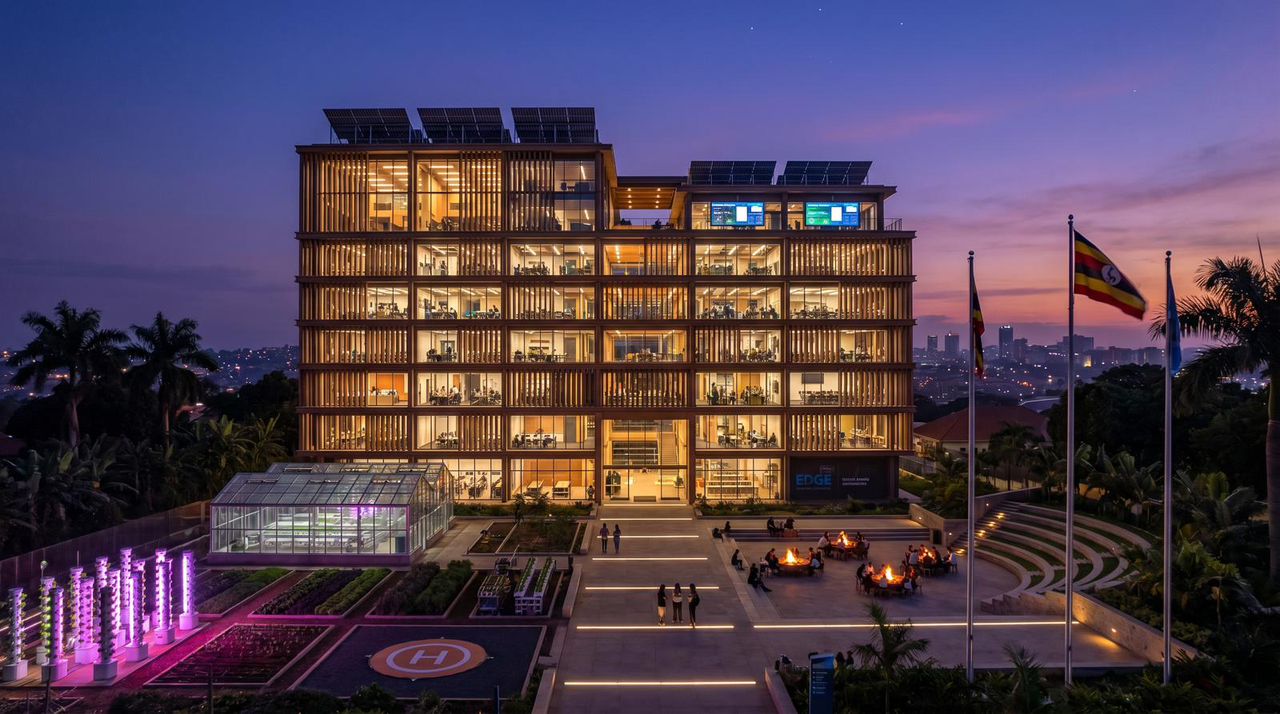
National Certificate in Agricultural Technology and Irrigation
Agriculture employs more Ugandans than every other sector combined, and the Parish Development Model has made raising farm incomes the centre of national policy.
Pricing Model 5.1 · The Forward Standard
National Certificate in Agricultural Technology and Irrigation fee
UGX 900,000 per year
Forward College programmes carry no laboratory premium. The whole-programme total follows the published annual anchor and this programme's duration.
- Laboratory tier
- No laboratory premium
- Annual premium
- UGX 0
- Per semester
- UGX 450,000
- Whole programme
- UGX 1,800,000
- Approximate USD
- ≈ USD 474
What this fee includes
- Teaching, practice tutoring, assessment and competency verification
- The Amagezi platform and AI tutor around the clock
- All learning materials
- Every examination, including first resits
- Identity card, library, guild, sports and basic wellbeing
- Co-op placement matching and the Capability Passport
- Graduation and the statutory NCHE fee
- Online application
Occupational profile
What you'll be paid to do
Agriculture employs more Ugandans than every other sector combined, and the Parish Development Model has made raising farm incomes the centre of national policy.
The binding constraint is technical: water in the dry season, machinery that works, crops protected and produce kept.
Every district now hosts irrigation programmes, commercial farms, agro dealers and equipment suppliers competing for a technician who barely exists: someone who can survey, install, run and repair the technology of modern smallholder farming.
The graduate works as any of the following, employed or self employed, in every farming district: business employed provider agro dealers employed technician and flower producers, monthly
| Occupation | Where the work is | Starting earnings, observed 2026 |
|---|---|---|
| Irrigation installation and service technician | Irrigation companies, contractors, district programmes, own service business | UGX 400,000 to 800,000 monthly employed; per scheme rates self employed |
| Farm technology and machinery service provider | Commercial farms, machinery hire businesses, agro dealers | UGX 350,000 to 700,000 monthly; hire margins self employed |
The 90-Day Promise
From certification to income, stated concretely
Day Pathway Named employer categories with which the College holds or is concluding placement and hiring partnerships: irrigation companies and contractors; commercial farms and estates; district irrigation and production programmes; outgrower schemes; and drone service providers.
Partnership target: twenty active partners by the first cohort's year two training, each offering at least two placements.
The ninety day pathway from certification to income:
Day 0: graduation with the Capability Transcript, the mentor's reference, and an exit project that is already a trading service or a completed scheme.
Day 0: graduation with the Capability Transcript, the mentor's reference, and an exit project that is already a trading service or a completed scheme.
Days 1 to 30: employed route: three arranged interviews with placement hosts who already know the graduate's work. Self employed route: the venture's contracts continue; the mentor reviews month one.
Days 31 to 90: employed route: probation support from the practice tutor. Self employed route: referral listing for partner overflow work and district programme subcontracts, standing terms in the partnerships.
Measurement: employment or trading status recorded at day 90 and published in the annual outcomes report, per Part Two, section 2.9.
Programme structure
Every module, with its arithmetic
One credit unit equals ten notional learning hours. 240 credit units, 2400 notional hours: 655 contact, 1225 practical and 330 industrial hours, so practical and industrial hours are 65 per cent of the programme.
h and and n y and One for and and y Two ent Practical and industrial hours together are 1555 of 2400 notional hours, 65 per cent, meeting the hands on test.
Semester 1
| Code | Module | CU | Contact h | Practical h | Industry h |
|---|---|---|---|---|---|
| AGR101 | Farm Safety, Hand Tools and Field ConductSafety on farms is different from safety in workshops: chemicals, machinery, animals, sun and water. The learner becomes safe in all of them before touching any of them. | 6 | 20 | 30 | 0 |
| AGR102 | Soils, Water and Crop FundamentalsIrrigation without agronomy is plumbing. The learner learns how soil holds water, how crops drink it, and how Uganda's seasons and soils vary, because every later design decision depends on it. | 14 | 50 | 70 | 0 |
| AGR103 | Irrigation Hydraulics and PumpsWater moves by rules. The learner masters heads, flows, pipes and pumps at certificate depth: enough theory to size correctly, all of it practised on the rigs. | 14 | 50 | 70 | 0 |
| COM101 | Communication and Workplace SkillsTechnicians rise or stall on how they speak, write, listen and behave on site. Taught through the trade's own situations, never as abstract English. | 6 | 30 | 15 | 0 |
Semester 2
| Code | Module | CU | Contact h | Practical h | Industry h |
|---|---|---|---|---|---|
| AGR104 | Drip and Sprinkler InstallationThe core craft module of year one: the learner installs drip and sprinkler systems repeatedly, from headworks to emitters, until a clean, even, leak free system is habit. | 16 | 30 | 110 | 0 |
| AGR105 | Greenhouse and Nursery PracticeProtected cropping is where irrigation skills earn most per square metre. The learner erects, equips and runs greenhouse production through a full crop cycle. | 12 | 35 | 75 | 0 |
| AGR106 | Farm Machinery Operation and Care | 12 | 35 | 75 | 0 |
| AGR107 | Water Sources and Rainwater HarvestingMechanisation is arriving at smallholder scale: two wheel tractors, pumps, sprayers and shellers. The learner operates and cares for the machines a service provider actually owns. | 8 | 25 | 55 | 0 |
| SPN201AI spine | AI Tools and Data on the FarmThe spine applied to agriculture: satellite and sensor advisories, AI crop diagnosis, spray and irrigation decision tools, used on the College's own crops and verified against ground truth. | 10 | 40 | 50 | 0 |
| ITR201 | Industrial Training OneTen assessed weeks in year one, under the Part Two policy: the learner works inside a commercial farm, irrigation contractor or agro dealer. | 16 | 0 | 10 | 150 |
Semester 3
| Code | Module | CU | Contact h | Practical h | Industry h |
|---|---|---|---|---|---|
| AGR201 | Solar Water Pumping for IrrigationYear two opens by joining the College's solar and agriculture strengths: the learner installs and runs solar pumping for irrigation, sharing rigs and standards with FC-C01. | 10 | 30 | 70 | 0 |
| AGR202 | Fertigation and Crop ProtectionFeeding and protecting crops through the irrigation system and the sprayer, lawfully and precisely, is the difference between a technician and a hazard. | 12 | 40 | 80 | 0 |
| AGR203 | Post Harvest Handling and StorageUganda loses a large share of what it grows between field and market. The learner learns to keep it: handling, cooling, drying, storing and grading, because saved produce is earned income. | 12 | 40 | 80 | 0 |
| AGR204 | Irrigation System Design and CostingThe capstone technical module: the learner designs and costs complete smallholder irrigation systems, honestly, and defends them like a professional. | 18 | 70 | 90 | 0 |
| AGR207 | Livestock Water SystemsCattle corridors and dairy zones buy water systems too: troughs, tanks and pasture lines. A short module that widens the graduate's market. | 6 | 20 | 40 | 0 |
Semester 4
| Code | Module | CU | Contact h | Practical h | Industry h |
|---|---|---|---|---|---|
| AGR205 | Precision Agriculture Field Technology | 14 | 50 | 80 | 0 |
| AGR206 | Irrigation Maintenance and TroubleshootingThe new tools of the trade: drones overhead, sensors in the soil, maps on the phone. The learner operates them at technician level and, more importantly, turns their outputs into field actions. | 12 | 35 | 85 | 0 |
| ENT101 | Trade EntrepreneurshipInstalled systems age: emitters block, filters foul, pumps tire, rodents chew. The learner becomes the technician who keeps schemes alive, the most reliable income in the trade. | 6 | 25 | 20 | 0 |
| SPN102AI spine | Digital Work and Platform IncomeThe shortest module with the fastest payback: how a technician finds customers, prices work, invoices and gets paid through digital channels. | 4 | 15 | 20 | 0 |
| ITR202 | Industrial Training TwoTwelve assessed weeks in year two at a higher level of responsibility: the learner should leave having led tasks, not only performed them. | 20 | 0 | 10 | 180 |
| EXP201 | Exit Venture or Employment ProjectThe programme's closing argument, specified in section 11 of this chapter: a real irrigation venture or a complete client project, defended in the oral examination room. | 12 | 15 | 90 | 0 |
The AI and Digital Practice Spine
AI, taught inside this trade
Applied Here The spine of Part Two, section 2.13, applied to agriculture: 14 credit units across SPN201 and SPN102, with the automation and judgement strands embedded in AGR205 and AGR202.
AI tools for my trade
Photo diagnosis of crop problems, verified by scouting; AI drafted designs and farmer reports, corrected by hand
Data in my trade
Soil moisture and weather data driving irrigation decisions; digital farm records that become bankable evidence
Working with automation
Injectors, controllers, drones and sensors as the trade's automation, operated and supervised by the technician
Judgement, ethics and safety
Label law over app suggestions; food safety intervals; honest advice about what the data cannot say
Digital work and platform income
Service profiles, digital quoting and mobile money for scheme and machinery services, from SPN102
Learning outcomes
What the graduate can do
- PLO 1
Survey, install and commission drip and sprinkler irrigation systems to design and standard
Level 3: performs abroad range of skilled tasks to standard
- PLO 2
Develop and protect water sources and install solar pumping for irrigation
Level 3: skilled tasks in varied field contexts
- PLO 3
Design and cost complete smallholder irrigation systems honestly
Level 3: gathers and uses information to plan work
- PLO 4
Operate and service farm machinery productively and safely
Level 3: operates workplace equipment with responsibility
- PLO 5
Run greenhouse production through a full crop cycle
Level 3: applies known methods with responsibility for outcomes
- PLO 6
Apply fertigation and crop protection lawfully, precisely and on the record
Level 3: works within regulation with responsibility
- PLO 7
Handle, store and grade produce to minimise loss and meet buyer standards
Level 3: quality responsible task performance
- PLO 8
Maintain and troubleshoot irrigation and pumping systems as a professional service
Level 3: solves routine problems by known methods
- PLO 9
Operate precision agriculture tools, drones, sensors and advisories, and convert data into honest field advice
Level 3: uses workplace technology effectively
- PLO 10
Apply field safety and agrochemical law without exception
Level 3: responsibility for safety of self and others
- PLO 11
Communicate with farmers, buyers and teams clearly and honestly
Level 3: communicates across familiar contexts
- PLO 12
Operate as a compliant self employed service provider or productive employee
Level 3: works independently within scope
Entry routes
Four ways in
- Academic route. Uganda Certificate of Education; a pass in agriculture, biology or mathematics preferred but not required.
- Vocational route. A relevant lower TVET certificate or completed agricultural course with field experience.
- Recognition of prior learning. Practising farm and irrigation technicians assess against the outcomes; competence is credited and the learner completes what remains, commonly the design, precision and spine modules.
- Mature age route. Applicants of twenty five and above enter through the access assessment of literacy, numeracy and trade aptitude.
Industrial training
Assessed weeks inside a working organisation
- Duration and placement
- Ten weeks in year one (ITR201, 16 credit units, 150 hours minimum) and twelve weeks in year two (ITR202, 20 credit units, 180 hours minimum).
- Host organisation types
- Commercial farms and estates, irrigation companies and contractors, district irrigation and production programmes, agro dealers and machinery suppliers, greenhouse producers, and drone and data service providers.
- Learning objectives
- Year one: perform installation, field production and machinery work under supervision. Year two: lead tasks, hold a small host project, and experience costing, customers and scheme management.
- Supervision
- A named host supervisor; the practice tutor visits at least twice per placement; escalation within three days per the Part Two policy.
- Logbook
- Daily entries against the objectives, countersigned weekly by the host supervisor, reviewed by the practice tutor at each visit, kept on the platform.
- Assessment
- Joint workplace assessment against the practice rubric each year, plus logbooks and the year two host project.
Assessment and certification
Continuous practical, plus UVTAB
A human assessor confirms every AI-avatar oral examination result before it stands, and the trainer who taught a learner never marks that learner's summative assessment.
- Internal continuous assessment, 60 per cent: workshop task assessments, module projects, logbooks and oral checkpoints, marked under the separation rule of Part Two.
- UVTAB external assessment, 40 per cent: the Board's written and practical occupational assessments for this qualification, taken at the gazetted sittings.
- Practical competency assessment: every practical outcome is assessed by observed performance against published criteria; evidence is retained.
- Oral examination option: any module checkpoint and the exit project defence may be taken in the AI avatar oral examination room, with human confirmation of every result.
- Grading scale: Distinction 80 to 100; Credit 65 to 79; Pass 50 to 64; Not Yet Competent below 50, with the right to reassessment.
- Pass and progression: every core module at Pass or above, all practical competencies demonstrated, industrial training completed, exit project at Pass or above.
- Resit rules: two reassessment opportunities per module without repeating attendance; a third attempt repeats the module; reassessment covers only the outcomes not yet demonstrated.
Exit project
A real venture, or a real employer brief
Venture route: launch an irrigation and farm technology service business: the and two maintenance contracts executed and documented, and a twelve month cash plan.
Employment route: deliver a complete irrigation scheme project for a real or College sourced client, from survey and design through installation, commissioning, farmer training and a maintenance plan, to employer standard.
Deliverables:
The project file: survey, design, bills of quantities, and for the venture route the demand study and registration evidence The physical work: the scheme or contracts, inspected and attested The commercial record: invoices, payments, farmer sign off The defence: presentation and oral examination, human confirmed Grading criterion Weight What excellent looks like Technical quality 35% The scheme meets design Agronomic sense 15% Crop, soil and schedule viability costs complete; the Defence 10% Every decision explained
- The project file: survey, design, bills of quantities, and for the venture route the demand study and registration evidence
- The physical work: the scheme or contracts, inspected and attested
- The commercial record: invoices, payments, farmer sign off
- The defence: presentation and oral examination, human confirmed Grading criterion Weight What excellent looks like Technical quality 35% The scheme meets design Agronomic sense 15% Crop, soil and schedule viability costs complete; the Defence 10% Every decision explained
Progression
Where this qualification leads next
No Forward College learner ever meets a dead end.
Within Forward College: graduates enter FC-D07, the Diploma in Agro Processing and Post Harvest Technology, or FC-D08, Drone Operations and Geospatial Survey, with the certificate's cognate credits recognised; the year one standalone award stacks fully into the two year certificate.
Into Forward University: the staircase runs certificate to diploma to higher diploma to the cognate agricultural and engineering degrees, with credit transfer of up to one third under the Part Two, section 2.12 equivalence tables.