

Admissions1 min read
Admissions answers move to WhatsApp, in four languages
LEO and Ask Forward now answer in English, Luganda, Swahili and French, with voice input, read-aloud, a low-data mode and an installable offline app.
Read the full article
Forward has no alumni, no rankings and no graduate outcomes to report. What it publishes is what it has actually done, dated, plus the thinking behind it.
Latest
University news, insight pieces from the academic team, student stories and dated institutional statements share a single stream. Filter by topic below.
LEO and Ask Forward now answer in English, Luganda, Swahili and French, with voice input, read-aloud, a low-data mode and an installable offline app.
Read the full article
Ten programmes join the catalogue, taking Forward to 143 published degree and certificate programmes across eleven Schools.
Read on
Mwalimu and LEO now sit under a standing board with a published incident register and a named academic accountable for every behaviour.
Read on
Forward publishes its fee structure, funding routes and payment rules before applications open, with every figure marked pending Council approval.
Read on
An open catalogue of AI courses for anyone, separate from the degree catalogue and explicitly outside NCHE degree accreditation.
Read onAI in the world
An external reading list gathered from public reporting on 14 September 2026. Every item links to the original publisher. These are not Forward statements, and appearing here is not an endorsement.

Microsoft set out a code of conduct placing people above automated systems, framed as a response to mounting safety concerns about how AI products behave.
Why it matters here: Forward's own rule sits in the same territory and is already written into the assessment regulations: software never issues a mark.

Hinton told the ABC there is significant risk in the current pace of development, supporting Anthropic's call for a global slowdown.
Why it matters here: Read alongside the refusal list: Forward teaches AI practice, and it teaches the arguments against building a thing at all.

Major AI firms have held talks about an industry-run standards organisation, raising the question of who sets the rules and who audits them.
Why it matters here: A governance question students meet directly in the Forward Core: self-regulation, public regulation, and who is accountable when neither holds.

A managed harness for agents that hold context, use tools and coordinate subagents over long-running tasks rather than single prompts.
Why it matters here: The shift from prompting to supervising agents is the skill our AI and Digital Practice Spine assesses across every School.

Nvidia is working with Australian partners to build significant additional AI compute capacity as demand continues to outrun supply.
Why it matters here: Compute, power and cooling are engineering and climate problems before they are software ones, which is why they are taught as such here.
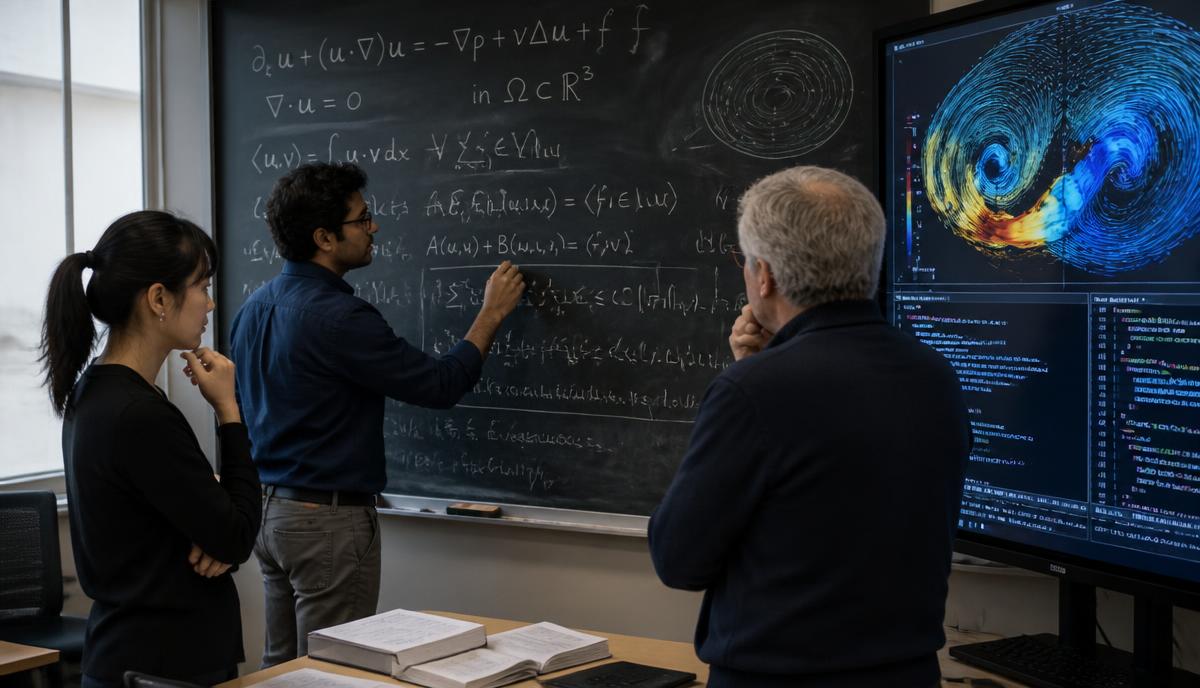
An internal system produced a proof concerning existence and smoothness for the Navier-Stokes equations, released for review with a written argument.
Why it matters here: Machine-produced mathematics still has to survive human peer review. That verification habit is what our published rubrics train.

Perplexity reports using a frontier model to write communications, change software and monitor production, with far fewer human check-ins than before.
Why it matters here: Employers on cooperative-education placements now expect graduates who can audit this work, not just produce it.
Milestone log
The governing body adopted the academic model in full: nine Schools, a compulsory Forward Core in every programme, a compulsory twelve-month paid and assessed cooperative-education placement, and a published refusal list naming what the university will not teach.
The full academic architecture was fixed before recruitment opened, including the School of Energy, Climate and Earth Systems. Departments were mapped to the labour-market thesis each School is accountable for, rather than to existing faculty interests.
Twelve programmes form the first accreditation wave and are the only programmes accepting applications. The remaining planned programmes are published as placeholders with no entry route, and will not open until their own wave clears review.
Each of the five Core requirements now has a rubric that is graded inside programme modules rather than bolted on as a separate certificate. Moderation is being run across Schools so a Core grade means the same thing in engineering as it does in the arts.
Placements must be paid, twelve months long and assessed against the same rubric everywhere, which rules out unpaid internships and shadowing. Because the placement is compulsory, no cohort will be admitted larger than the confirmed placement capacity for that intake.
The Academic Tower, instrumented laboratories, library spine and student services hub are being delivered as one package so that the founding intake does not study on a building site with borrowed rooms.
Applications are being accepted for the twelve first-wave programmes. Zero students are enrolled, so every published figure on the accountability page is a live count rather than a projection.
Sessions are scheduled in three time bands so applicants in West Africa, East Africa, Europe, the Gulf and the Americas can attend one live rather than watching a recording. Each session covers the Core, the co-op requirement and the refusal list.
Design is complete for the Phase Two enterprise and cooperative-education building. Construction is sequenced to follow the founding intake so that teaching capacity is never traded for a showpiece.
Information sessions
Sessions run in rotation rather than on a single Kampala-only schedule. Each covers the Forward Core, the compulsory twelve-month paid cooperative-education placement, and the refusal list.
09:00 East Africa Time (UTC+3)
East & Southern Africa, Gulf, South Asia
Focus: Programme scope, Forward Core, entry requirements
14:00 East Africa Time (UTC+3)
West & Central Africa, Europe, United Kingdom
Focus: Cooperative education, employer expectations, fees
19:00 East Africa Time (UTC+3)
Americas, Caribbean
Focus: Study permits, timelines, remote and hybrid study